Hyperliquid HIP-3 markets: who lists the stock and gold perps, what they cost, and what happens when the real market closes

Key takeaways
- Someone other than Hyperliquid runs each HIP-3 market. 10 teams have registered one; 4 still had a live market on 8 Oct 2026, and 144 markets had been delisted.
- One deployer is nearly the whole thing. trade[XYZ] (
xyz) carried 97% of the day’s HIP-3 volume. - The fee depends on the market, not the venue. 147 of 158 live markets were in growth mode at 0.009% taker; GOLD is barred from growth mode and charges 0.09% — ten times as much.
- Closed-market hours have their own rules. TSLA can drift at most about +15.8% / −14.3% from the Friday close until the real market reopens — and then it can gap.
- Most HIP-3 markets are isolated-only. 131 of 158 do not allow cross margin, which also means no backstop liquidator for them.
What is a HIP-3 market, in one paragraph?
HIP-3 is the Hyperliquid rule that lets an outside team list its own perpetual futures market on Hyperliquid’s matching engine. The documentation sets out the deal: the deployer is responsible for “market definition, including the oracle definition and contract specifications” and for “market operation, including setting oracle prices, leverage limits, and settling the market if needed”. In exchange it must keep 500,000 HYPE staked. You trade the market with the same wallet, the same order types and the same USDC as any other Hyperliquid perp. What changes is who answers for the price you are trading against.

Hyperliquid says it plainly before you can trade: these markets are “not reviewed, verified, or approved”, and they may involve “low liquidity, high volatility, incomplete documentation, and increased liquidation risk”. That pop-up is the most honest summary of HIP-3 there is, and it is the venue’s own. The rest of this page is what those four risks look like in numbers.
Who actually runs the market you are trading?
The name in front of the colon. On Hyperliquid a HIP-3 market is written dex:ASSET — xyz:TSLA, para:10Y — and the part before the colon is the deployer. We asked the public API for every deployer and every market it lists:
| Deployer (dex tag, name it registered) | Live markets | Delisted markets | 24h volume |
|---|---|---|---|
xyz XYZ | 114 | 18 | $2,365.4M |
io EntropyIO | 9 | 2 | $61.8M |
para Paragon | 30 | 8 | $5.5M |
mkts Markets By Kinetiq | 5 | 19 | $2.6M |
flx Felix Exchange | 0 | 16 | — |
vntl Ventuals | 0 | 15 | — |
hyna HyENA | 0 | 25 | — |
km Markets by Kinetiq | 0 | 23 | — |
abcd ABCDEx | 0 | 1 | — |
cash dreamcash | 0 | 17 | — |
Two things in that table are worth more than any feature list. First, concentration: one deployer, trade[XYZ], carried 97% of the day’s HIP-3 volume. HIP-3 as a whole did $2.44 billion against $5.99 billion on Hyperliquid’s own perps — 29% of the combined total. Second, attrition: 144 markets had already been delisted, and 6 of the 10 deployers had none left at all.
A delisting is not abstract. The deployer settles a market with one action, haltTrading, which per the docs “cancels all orders and settles positions to the current mark price”. Your position ends at whatever the mark is at that moment. If the deployer misbehaves, validators can slash its stake — but the docs are explicit that “the slashed stake by the deployer is burned instead of being distributed to affected users”. The 500,000 HYPE is a deterrent, not an insurance fund for you.
How much does a HIP-3 trade really cost?
Not the number on Hyperliquid’s fee page. That page’s 0.045% taker rate is for the venue’s own perps. For HIP-3 the docs add a deployer share of 0–300% on top, and when the share is above 100% “the protocol fee is also increased to be equal to the deployer fee”. Hyperliquid publishes the formula in code; we ran it for the settings we found in the API. 157 of 158 live markets use a 100% share, which doubles the base rate to 0.09%. Then “growth mode”, which the deployer can switch on for non-crypto markets, cuts that by 90% to 0.009%.
| Market type | Examples on 8 Oct 2026 | Taker fee, each way | $10,000 in and out |
|---|---|---|---|
| HIP-3 market in growth mode | TSLA, NVDA, S&P 500, oil | 0.009% | $1.80 |
| Hyperliquid’s own perps (not HIP-3) | BTC, ETH | 0.045% | $9.00 |
| HIP-3 market without growth mode | GOLD, MSTR | 0.09% | $18.00 |
| HIP-3 ceiling the protocol allows | 300% deployer share | 0.27% | $54.00 |
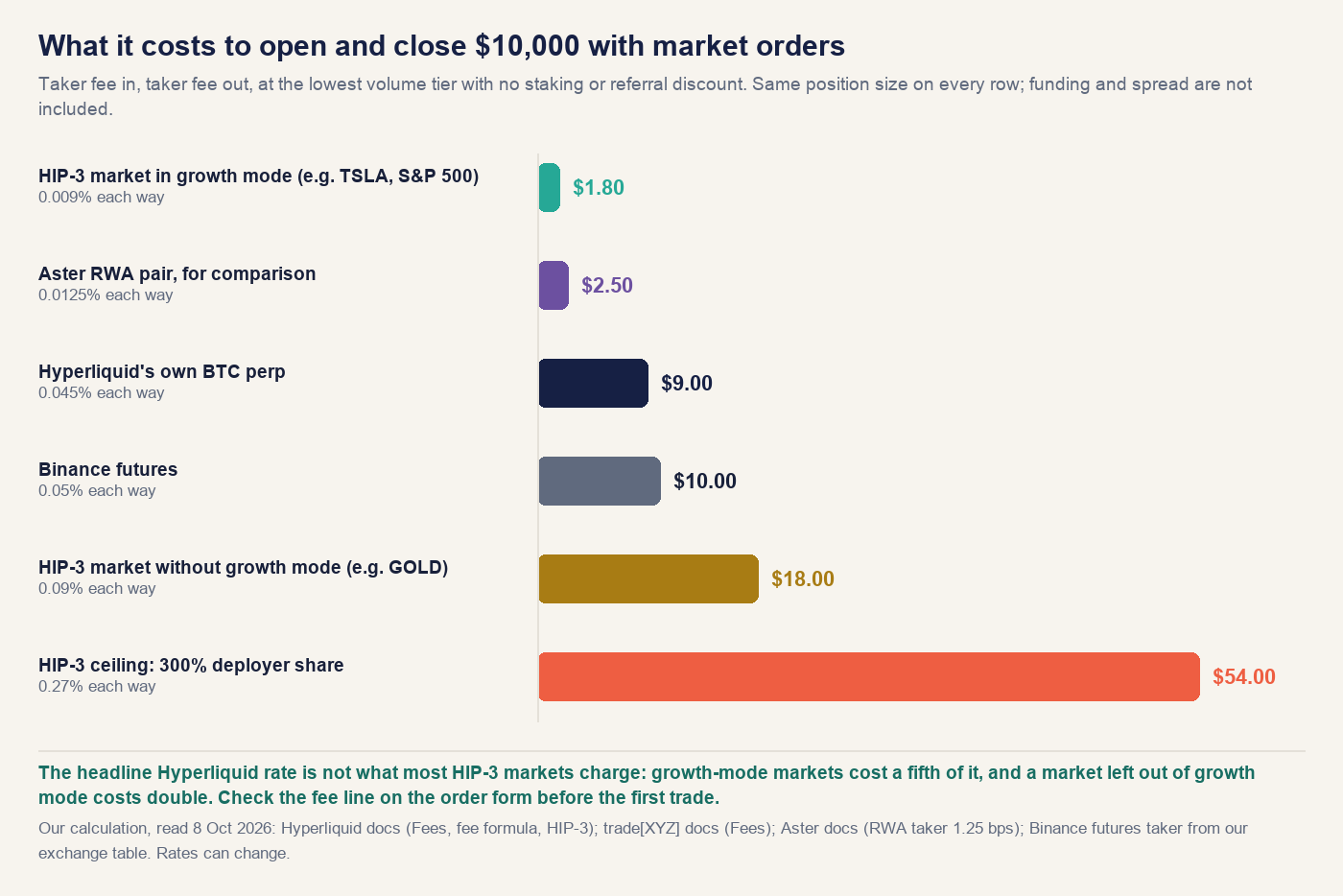
The catch is in which markets get the cheap rate. Hyperliquid bars growth mode for anything that overlaps an existing market — crypto perps, crypto baskets, wrappers that mostly hold crypto (the trade[XYZ] page names MSTR), and “perps tracking gold price, because PAXG-USDC already tracks gold price”. So on the same screen, S&P 500 costs $1.80 in and out on $10,000 while GOLD costs $18.00. GOLD still did $94 million of volume that day; plenty of people are paying the higher rate, and many of them probably do not know it. For a sense of scale against another on-chain venue: Aster’s documentation lists a flat 1.25 bps taker fee on its real-world-asset perps, and our Hyperliquid vs Aster comparison covers the rest of that match-up.
What happens to your position when the stock market is closed?
This is the part that makes a stock perp different from a crypto perp, and it is the part most write-ups skip. A HIP-3 market needs an oracle price around the clock, but the stock it tracks does not trade around the clock. trade[XYZ]’s documentation explains what fills the gap: while the external market is open, the oracle follows external prices; when it closes, the oracle “advances via a continuous-time exponentially weighted moving average” of the perp’s own order book, with a 30-minute time constant. In other words, at the weekend the price of the TSLA perp is set by the people trading the TSLA perp.

xyz tag is the deployer, and 20x is its leverage cap. Middle box: mark 377.52 against oracle 377.33. Right box: the hourly funding rate. Interfaces change — what you see may differ.You can see the two prices side by side on the market header. When we looked, the mark was 377.52 and the oracle 377.33 — about 0.05% apart, with the external market feeding the oracle. The funding box shows 0.0006% an hour: the API gives it to more decimals, 0.0006% an hour, which on a $10,000 long is about $1.50 a day. Funding is hourly on Hyperliquid and capped at 4% an hour, far looser than on a centralised exchange, and it does not stay small on every market: the same snapshot had natural gas paying 0.0528% an hour, which would be $127 a day on $10,000 if it held.
So what stops a weekend price from running away on a thin book? “Discovery bounds”. The mark can only move ±(1 ÷ max leverage) around a reference price, which starts at the last external close. When the price gets near the edge, the window steps to a new reference, a fixed number of times, and then stops.
![Phone screenshot of the trade[XYZ] documentation page on discovery bounds, with two sentences highlighted: a position whose liquidation price lies outside the active bounds cannot be liquidated while those bounds are in effect, and the bounds restrict the mark price to plus or minus one over max leverage around a reference price](/assets/art/dex-hip3-discovery-bounds-mobile.webp?v=f7fc1b3e)
We worked the maximum closed-session range out from the published settings, because the deployer’s page shows only one example. TSLA: 20x, ±5%, two steps — at most about +15.8% or −14.3% from the Friday close. GOLD: 25x, ±4%, two steps — +12.5% / −11.5%. HOOD: 10x, ±10%, one step — +21% / −19%. Then, when the real market reopens, the oracle goes back to following the external price. Each price update is clamped to 0.5%, but the deployer’s risk page warns that the return can still produce “rapid or sequential price movements”, and that a cap on each update “does not guarantee that cumulative movements will be small”.
Here is what that means for a $10,000 TSLA long opened on a Friday evening with isolated margin. We used Hyperliquid’s published liquidation formula and TSLA’s maintenance margin of 2.5% (half the initial margin at its 20x cap):
| Leverage on a $10,000 TSLA long | Margin posted | Price fall to liquidation | Reachable while the stock market is closed? |
|---|---|---|---|
| 3x | $3,333 | −31.6% | No — beyond the whole closed-session range, but a reopening gap can still reach it |
| 5x | $2,000 | −17.9% | No — beyond the whole closed-session range, but a reopening gap can still reach it |
| 10x | $1,000 | −7.7% | Not at first; yes once the bound has stepped down once |
| 20x | $500 | −2.6% | Yes — inside the very first bound |
Read the last column with care. The docs say a position whose liquidation price is outside the active bounds “cannot be liquidated while those bounds are in effect” — true, and it sounds like protection. It is a delay. At 10x your liquidation sits 7.7% away: safe in the first window, reachable after one step. At 3x or 5x the weekend cannot reach it, but Monday’s reopening can, and you have had all weekend to watch it coming with no way to trade the real stock. Size for the gap, not for the window. Our liquidation price calculator will give you the distance for your own numbers.
What else is different from a normal Hyperliquid perp?
- Isolated margin is the norm. 131 of 158 live markets were isolated-only (10 of them “strict”, where you cannot take margin back out). Only 27 allowed cross margin. That matters beyond convenience: the docs say the on-chain backstop liquidator “only accept[s] assets where cross margin is enabled”, so on an isolated-only market a position the order book cannot absorb goes straight to auto-deleveraging.
- Leverage caps are set by the deployer, and some are higher than Hyperliquid’s own. Hyperliquid’s docs give 3–40x for its perps; 4 HIP-3 markets allowed 50x. The most common cap was 10x.
- Open interest is capped per market. When a market hits its cap, trade[XYZ] says “new positions cannot be opened” and only reductions are allowed — which can crowd everyone toward the exit at once.
- You own nothing underneath. The deployer’s risk page: the contracts give “synthetic price exposure” with no ownership, voting or dividend rights, and settle in USDC, which “is not the same asset as a U.S. dollar”.
- Leverage is still checked only once. As on every Hyperliquid perp, it is checked when the position opens; after that, the distance to liquidation is yours to watch. More on that in our funding and liquidation guide.
Anyone who has not traded a crypto perp on Hyperliquid first. HIP-3 adds a deployer, a second oracle regime and closed-market rules on top of everything a normal perp already asks of you. Start with how to start on Hyperliquid and the self-custody checklist.
Anyone who wants to own shares. A perp gives price exposure and nothing else. If owning the stock is the point, a regulated broker is the tool, and our exchange comparison is not where that search ends.
Anyone planning to hold leveraged stock perps over a weekend without having done the table above for their own size.
IF YOU HAVE READ THE MARKET’S SPECIFICATION
Affiliate disclosure first: the button below is a referral link. Hyperliquid may pay us a share of fees if you trade through it, at no extra cost to you. It changes nothing on this page — see our disclosure policy.
Two things no fee table prints. You hold the keys: a lost seed phrase is lost money, and there is nobody to appeal to. And the venue checks your leverage once, when the position opens, never again. If you still want to try a HIP-3 market, open the deployer’s specification page first, check the fee line on the order form, use isolated margin and a size that survives the closed-session range for that market.

Referral link — we may be paid if you trade through it. Hyperliquid is not available to US persons, and readers in the UK see no venue links on this site. Leveraged perps can lose more than you expect, fast. Education only.
Common mistakes
- Assuming Hyperliquid vetted the market. Its own pop-up says the opposite. Read the deployer’s documentation; it is linked from the banner on every HIP-3 market.
- Quoting the 0.045% headline fee. A HIP-3 market can charge a fifth of it or double it. The rate on the order form is the only one that counts.
- Treating the weekend price as the stock price. It is the perp’s own order book, inside bounds. Monday’s open decides what it was worth.
- Reading “cannot be liquidated while bounds are in effect” as safety. It postpones the liquidation to the next step or the reopening.
- Using cross margin habits on an isolated-only market. You cannot lean on the rest of the account, and there is no backstop liquidator behind it.
- Forgetting the market can end. 144 HIP-3 markets were delisted by 8 Oct 2026; settlement is at the mark price when the deployer halts.
Frequently asked questions
What is a HIP-3 market on Hyperliquid?
A perpetual futures market that an outside team, not Hyperliquid’s validators, has listed on Hyperliquid’s order-book engine. The deployer stakes 500,000 HYPE and is responsible for the market’s definition, its oracle prices, its leverage limits and, if needed, settling it. Stock, index, commodity and currency perps on Hyperliquid are HIP-3 markets.
Are HIP-3 fees higher than normal Hyperliquid fees?
It depends on the market. The standard HIP-3 rate is double the normal rate — 0.09% taker at the lowest tier instead of 0.045% — but markets in growth mode charge about a tenth of that, 0.009%. Gold and crypto-linked markets cannot use growth mode. The rate on the order form is the one that applies.
Can I trade Tesla or the S&P 500 on Hyperliquid at the weekend?
The perps keep trading, but the oracle no longer follows the real market. On trade[XYZ] markets it moves with the perp’s own order book, inside bounds that step in fixed amounts. For TSLA that is at most about +15.8% or −14.3% from the Friday close until the external market reopens.
Do I own the stock when I trade a HIP-3 stock perp?
No. The deployer’s own risk page says these contracts give synthetic price exposure only, with no ownership, voting or dividend rights, and they settle in USDC, not dollars.
What happens if a HIP-3 market is shut down?
The deployer can halt it with a single action that cancels all orders and settles every position at the current mark price. On 8 Oct 2026 the public API listed 144 delisted HIP-3 markets across 10 deployers, and 6 of those deployers had no live market left.
Keep going: the Hyperliquid profile, Hyperliquid fees explained, funding and liquidation on Hyperliquid, Hyperliquid vs Aster, what a DEX is and the exchange comparison.