How to read the funding rate on OKX
Almost every guide to this screen tells you the same thing: funding is charged every eight hours, positive means longs pay, done. Two of those three facts are conditional, and the condition is printed on the screen in brackets where most people never look. This guide walks the panel field by field, works the cost out on OKX’s own published example, and then shows the mechanism that turns a boring 0.01% into something worth planning around — a rule OKX documents openly and that changes your contract’s billing schedule without sending you anything.
KEY TAKEAWAYS
- A funding rate is meaningless without the bracket beside it. The same 0.0100% costs twice as much per day on a 4-hour contract as on an 8-hour one.
- OKX shortens a contract’s settlement interval automatically when the rate reaches its cap, with no notice. On OKX’s own example schedule that takes about three hours; unwinding it takes about thirteen.
- A shorter interval is not more expensive in normal conditions — OKX divides the rate by 8/N to cancel it out. The cap is the one number that is not divided, so only the worst case scales.
- Funding is charged on position value, never on the margin you posted. At 20× leverage a 0.1% rate is 2% of your margin.
Where is the funding rate on the OKX screen?
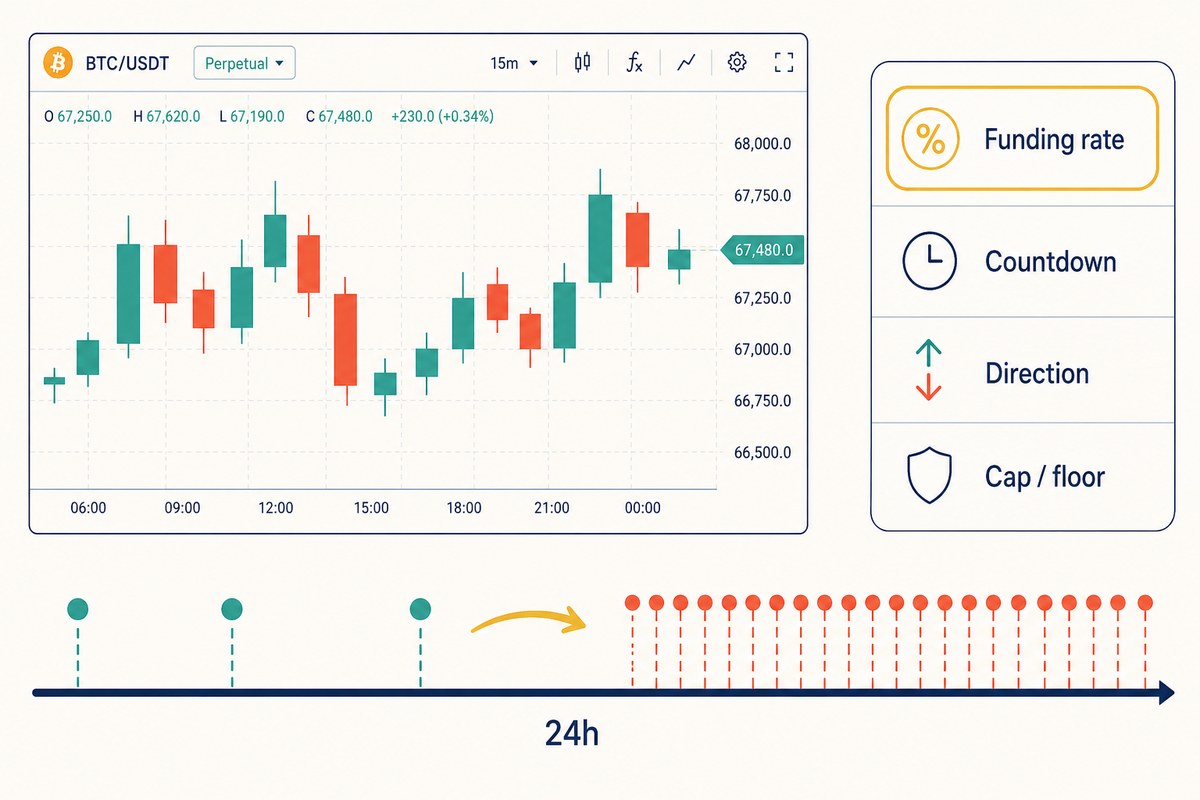
In the header of the trading dashboard on the web, and at the top of the order panel in the app. On both, the thing you are looking for is a single field labelled Funding rate / Countdown. It shows a percentage and a clock, and until you select it that is all you get.
Selecting the field opens a details panel — the one drawn at the top of this page — with four things worth reading, in this order of importance:
- The interval, shown in parentheses next to the funding rate label. This is the field everyone skips and it changes the meaning of everything below it.
- Direction — which side pays at the next settlement.
- Funding rate cap / floor — the bounds on the rate for this contract.
- Current and annualised rate, plus the countdown to the next settlement.
There is a second route worth knowing: Information on the perpetual futures trading dashboard opens historical funding rates alongside the position tiers guide and liquidation history. The panel tells you what is about to happen; Information tells you what has been happening, which is the more useful of the two when you are deciding whether to hold overnight.
Everything in that panel belongs to one contract. OKX gives BTCUSDT Perpetual an 8-hour interval and COMPUSDT Perpetual a 4-hour one, and there is no reason two unrelated symbols should agree on either the rate or the clock. Reading a rate on one chart and carrying it to another is the single most common way to be confidently wrong here.
Who pays whom, and what does it actually cost?
When the rate is positive, longs pay shorts. When it is negative, shorts pay longs. OKX states plainly that it only moves the money between traders and keeps none of it — unlike a trading fee, funding is not revenue for the exchange, which is why it can go negative and pay you.
The formula is short:
Funding fee = Position value × Funding rate
Position value (USDT-margined) = contracts × contract size × contract multiplier × mark price
OKX works it through with a long of 10 BTCUSDT perpetual contracts at a mark price of 60,000 USDT, with 0.01 BTC of face value per contract. Position value is 60,000 × 10 × 0.01 × 1 = $6,000, and at a funding rate of 0.1% the fee is $6,000 × 0.1% = $6. We will keep that $6,000 position for the rest of this guide so every later number stays comparable.
Now the part the formula hides. Position value is not your money. If you opened that $6,000 position at 20× leverage you posted roughly $300 of margin, and the $6 fee is still $6. Measured against the position it is 0.1%. Measured against the margin actually at risk it is $6 ÷ $300 = 2% — per settlement. Three settlements in a day and you have paid 6% of your margin to hold a position that has not moved.
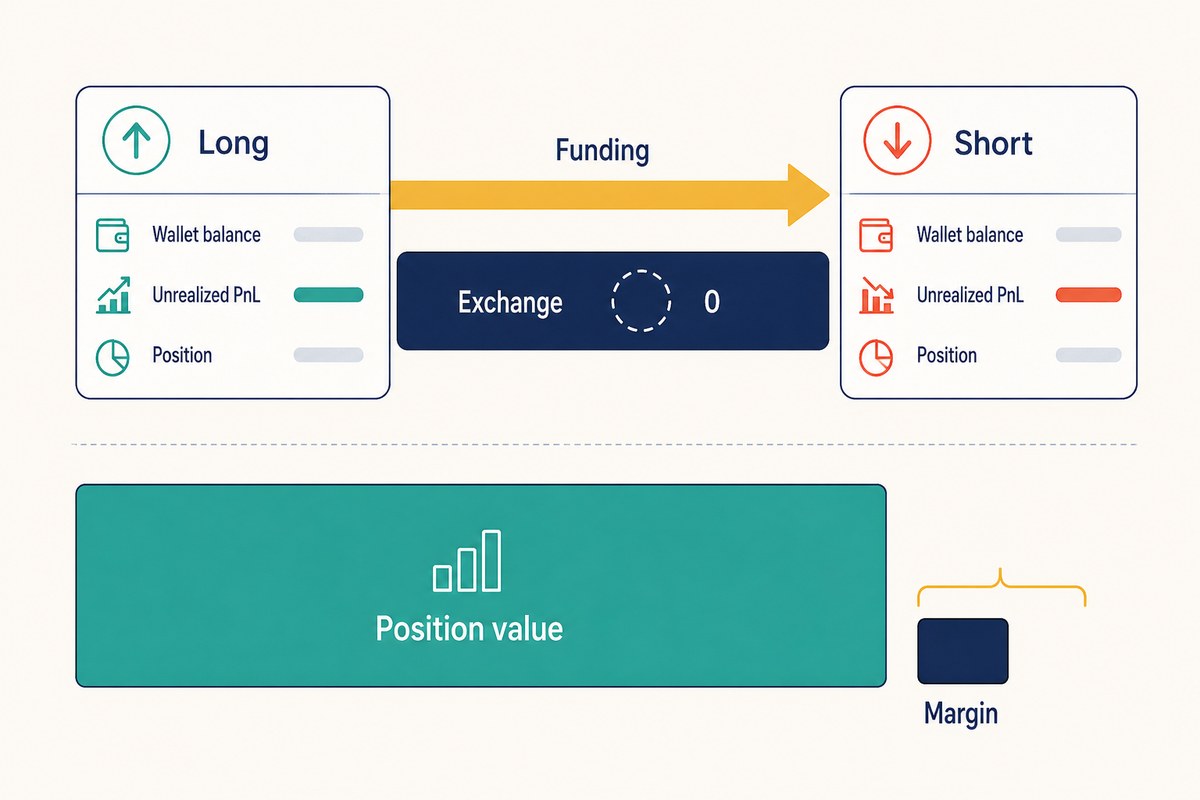
That money is taken from somewhere specific. In isolated margin mode OKX deducts it from the isolated margin of that position; in cross margin mode it comes out of the currency equity of the cross account. OKX warns in the same paragraph that the resulting drop in equity may trigger position size reduction or liquidation. Funding will not close a comfortable position. It quietly shaves the buffer on a marginal one, every single settlement, while you are asleep.
| Read from the panel | The question it answers | Why it changes your decision |
|---|---|---|
| Interval (in brackets) | How many times a day am I charged? | Turns a rate into a daily cost. Nothing else does. |
| Direction | Do I pay or get paid? | Decides whether holding is a cost or a credit. |
| Cap / floor | How bad can one settlement get? | Bounds per settlement, not per day — see below. |
| Countdown | Will I still be here? | You are liable if the position is open at assessment. |
| Your position value | What is the fee in dollars? | Percentages feel small; dollars against margin do not. |
Why does the bracket matter more than the rate?
Because two contracts showing the identical percentage can cost you different amounts for the same day of holding. The rate is a per-settlement figure. The bracket tells you how many settlements there are.
By default OKX settles every 8 hours, at 00:00, 08:00 and 16:00 UTC. Supported intervals are 1, 2, 4 and 8 hours, set per contract. So on our $6,000 position, a displayed rate of 0.0100% works out like this:
| Interval in brackets | Settlements per day | Cost per settlement | Cost per day |
|---|---|---|---|
| (8h) — e.g. BTCUSDT Perp | 3 | $0.60 | $1.80 |
| (4h) — e.g. COMPUSDT Perp | 6 | $0.60 | $3.60 |
| (2h) | 12 | $0.60 | $7.20 |
| (1h) | 24 | $0.60 | $14.40 |
Same number on screen, eight times the range of outcomes. This is why a funding figure quoted in a chat group or a screenshot is close to useless: without the bracket and the symbol, it does not carry enough information to be either right or wrong.
What happens when OKX speeds the settlements up?
It shortens the interval on its own, and it does not tell you. OKX publishes an automatic adjustment mechanism: when a contract’s funding rate reaches its cap or floor at a settlement, the settlement frequency escalates one level — 8h to 4h, 4h to 2h, 2h to 1h. Hit the cap again at the next settlement and it escalates again.
Here is OKX’s own worked example, for a contract whose default is 4 hours and whose cap and floor are ±0.375%.
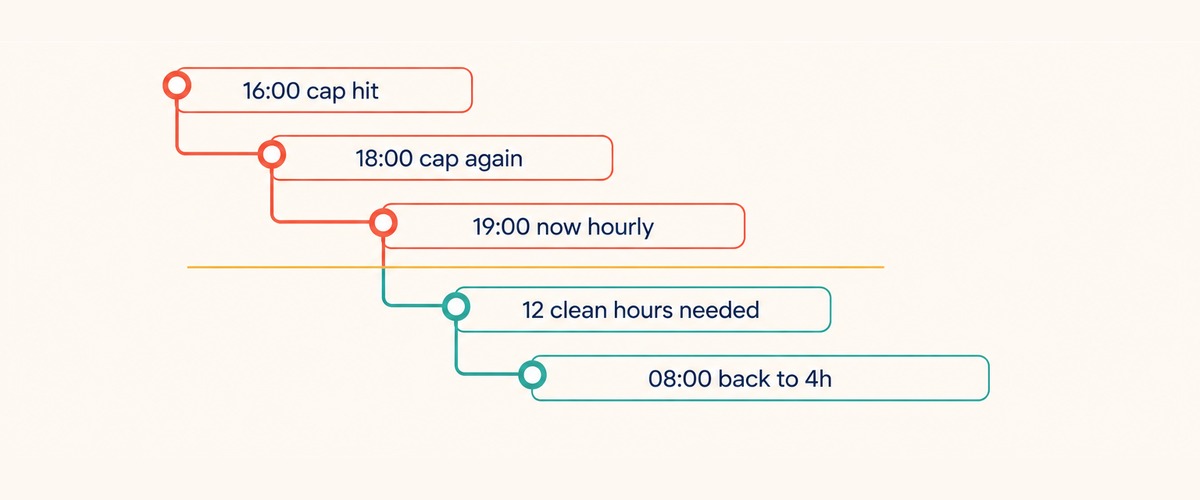
Coming back down is deliberately slower. OKX reverts to the default only when every settlement across 12 consecutive hours has stayed inside ±0.20%, and only checks that condition at a settlement time on the contract’s original schedule. Escalation is evaluated every settlement; reversion is evaluated a few times a day. In the example above, that asymmetry is roughly three hours up against thirteen hours down — our arithmetic, applied to OKX’s stated rule rather than a figure OKX publishes.
Two practical consequences. First, the interval you checked when you opened the position is not necessarily the interval you are being billed on tomorrow morning, so the bracket is worth re-reading rather than remembering. Second, escalation is a signal in itself: a contract that has been pushed to an hourly clock is one where the rate has been pinned at its limit repeatedly, and that is information about crowding you would otherwise have to infer.
Does a shorter interval actually cost more?
Usually no — and this is where most write-ups of the mechanism above go wrong. OKX divides the raw rate by 8 / N, where N is the interval in hours. On an hourly contract that is a division by 8; on a 4-hour contract, by 2. The stated purpose is to keep the daily-equivalent cost the same across cycles, and the arithmetic checks out: eight payments of one eighth is one payment.
OKX’s own example makes it concrete. On a 1-hour contract with an average premium index of 0.10%, the fixed interest rate of 0.01% gives 0.01% − 0.10% = −0.09%, clamped to −0.05%. Add that to the premium: 0.10% + (−0.05%) = 0.05%. Divide by 8 / 1 and the funding rate is 0.00625% per hour. Over 24 hours that is 0.15% — exactly what 0.05% charged three times on an 8-hour clock would have cost.
But the cap is applied after the division, not before. It is a bound on each settlement, and it does not shrink when the settlements multiply. That is the whole story in one line, and here is what it does to our $6,000 position at a cap of 0.375%, which is $22.50 per settlement at every cadence:
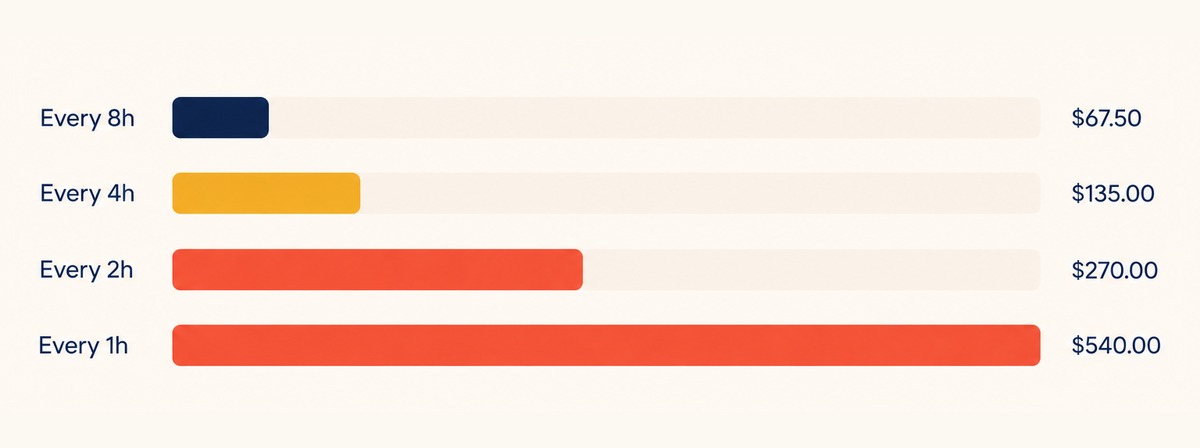
| Cadence | Settlements/day | Cap per settlement | Worst case per day | As % of position |
|---|---|---|---|---|
| Every 8h | 3 | $22.50 | $67.50 | 1.125% |
| Every 4h | 6 | $22.50 | $135.00 | 2.25% |
| Every 2h | 12 | $22.50 | $270.00 | 4.50% |
| Every 1h | 24 | $22.50 | $540.00 | 9.00% |
Read the two facts together and the design becomes clear. Normal conditions: the divisor cancels the faster clock and you pay the same. Extreme conditions: the rate is pinned at the cap, the divisor is no longer doing anything because the clamp has taken over, and the count is the only variable left. And escalation is triggered by hitting the cap — so you are only ever moved onto the fast clock in precisely the regime where the fast clock is expensive.
When this is the wrong way to think about it. If you are holding the perpetual as a hedge — long the spot, short the same size in the perp — price movement cancels out and funding is the entire position. Under that structure the cap regime is when the trade pays best, and an escalation to hourly settlement is good news rather than a warning. The mechanism is identical; only the sign flips. Everything above assumes you are directional, which is what almost everyone reading a funding rate for the first time is.
Can you close before settlement and skip the fee?
Technically yes. OKX exempts you if the position is closed before the fee is assessed, and voids the current cycle’s fee entirely if a contract is delisted before assessment. But the boundary is fuzzier than a clock face suggests: OKX notes that assessment can take up to a minute, and gives the example of a position opened at 00:00:20 UTC still being liable.
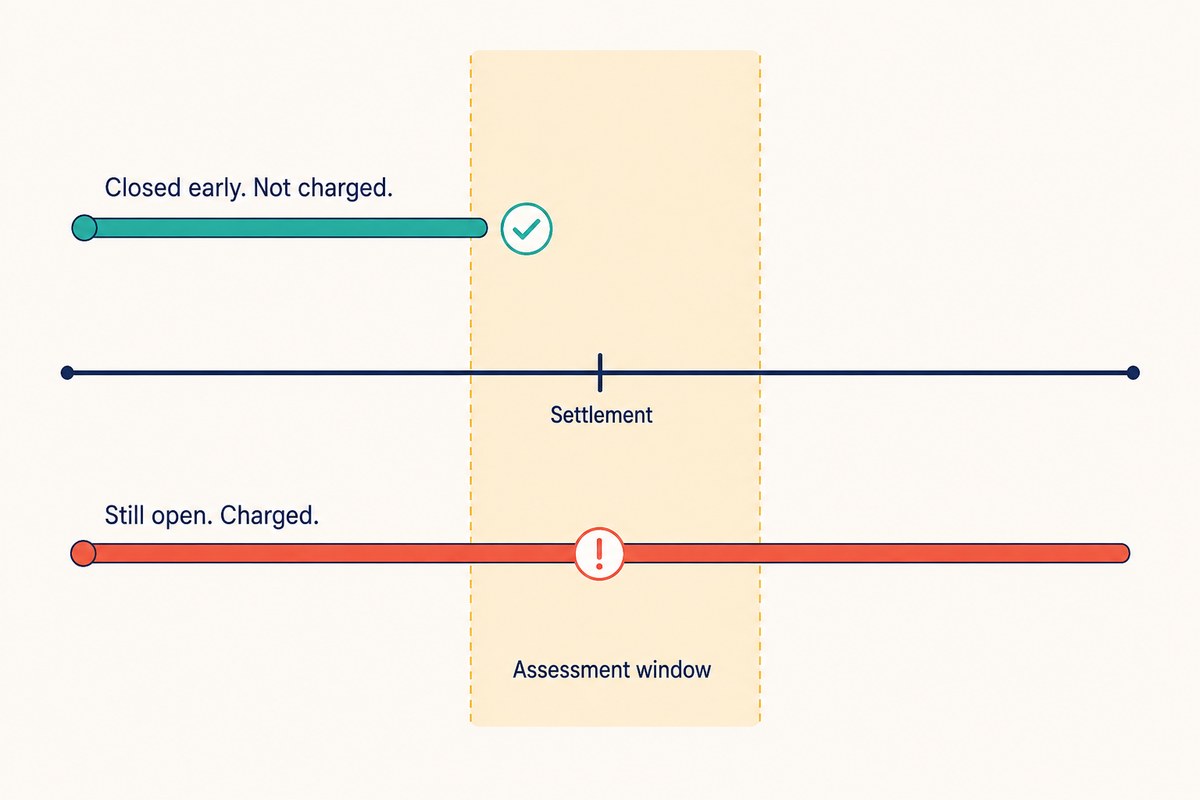
The bigger problem with entering a position purely to collect funding is arithmetic, not timing. On our $6,000 position a 0.1% rate is a $6 credit. With BTC at $60,000, a move of $60 — one tenth of one percent, a size BTC prints many times a day — is worth exactly $6 on that same notional. So the entire payment is cancelled by a price tick you cannot see coming, before you have paid two taker fees and crossed the spread twice.
That does not make funding irrelevant to a short-term trade. It makes funding alone a bad reason to open one. Funding is a holding cost to subtract from a position you already wanted; it is not an edge you can harvest by standing near a settlement time.
Is the annualised number on screen a yearly cost?
No. It is the current rate extrapolated as if it will never change, and the rate is recalculated every settlement from a premium index that moves constantly. The figure is a unit conversion, not a forecast — useful for comparing two contracts right now, misleading the moment you read it as a return.
Three annualisations of the same $6,000 position show why:
- 0.0100% every 8h → 0.03% a day → 10.95% a year. Plausible, and roughly the baseline the fixed 0.01% interest rate implies.
- At a 0.375% cap, every 8h → 1.125% a day → 410.6% a year.
- At the same cap, hourly → 9% a day → 3,285% a year.
Nothing pays 3,285% a year, and the screen is not claiming it does. It is describing one minute in a language borrowed from a year. Use the daily column instead: it is the horizon you actually hold over, and it is one multiplication away.
Common mistakes
Reading the rate and not the bracket. The percentage without the interval is an incomplete number. Two contracts at 0.0100% can differ by 8× in daily cost.
Applying the rate to your margin. Funding is charged on position value. On a leveraged position those two figures differ by the leverage multiple, and the margin is the one that gets liquidated.
Treating positive funding as a short signal. It says longs are crowded and the perp is trading above the index. Crowded trends run for weeks. Funding is a cost of being in the crowd, not a timing tool.
Assuming the interval you saw at entry is still current. OKX can escalate it automatically, and the escalation happens exactly when the rate is most expensive. Re-read the bracket, do not remember it.
Opening a position to collect a payment. On a $6,000 position a 0.1% credit is $6, and a 0.1% adverse move is also $6 — before fees and spread.
Ignoring funding on a position near its liquidation level. Each debit reduces equity. On a thin margin buffer, repeated settlements do the same work as a slow adverse move. Check the number in the liquidation price calculator against the buffer you have left.
Frequently asked questions
Is a positive funding rate on OKX a signal to short?
No. A positive rate tells you that longs pay shorts at the next settlement, which is a statement about crowding and about the gap between the perpetual price and the index. It is not a forecast. A rate can stay positive for days while price keeps rising, and paying funding all the way up is what a profitable long looks like.
How often does OKX charge funding?
Every 8 hours by default, at 00:00, 08:00 and 16:00 UTC, unless the contract specifies otherwise. Supported intervals are 1, 2, 4 and 8 hours, and the interval for each contract is shown in parentheses next to the funding rate label. OKX can also shorten a contract’s interval automatically when the rate reaches its cap or floor, then restore it once conditions settle.
Is funding charged on my margin or on my position size?
On position value. For a USDT-margined contract that is the number of contracts multiplied by contract size, contract multiplier and mark price. Leverage does not shrink it. A $6,000 position held on $300 of margin at 20× pays the same $6 at a 0.1% rate as an unleveraged $6,000 position would — which is 0.1% of the position but 2% of the margin behind it.
Can I avoid funding by closing just before the settlement time?
OKX exempts you if the position is closed before the fee is assessed, but assessment can take up to a minute, so opening at 00:00:20 UTC can still make you liable. More importantly, a round trip to collect one payment costs two taker fees and two crossings of the spread, and on a $6,000 position a 0.1% price move against you is worth exactly as much as a 0.1% funding credit.
Can a funding payment cause a liquidation?
It can contribute to one. OKX deducts the fee from the isolated margin of the position in isolated margin mode, and from the currency equity of the cross margin account in cross mode, and states that the resulting reduction in account equity may trigger position size reduction or liquidation. Funding does not liquidate a comfortable position; it erodes the buffer on a marginal one, every settlement.