Trading quotes that are actually documented
The internet credits famous traders with lines they never said, and the lines that spread fastest are usually the ones nobody can source. Every quote below is graded by the evidence behind it, then grouped by the lesson it teaches — because a quote you cannot check is just decoration.
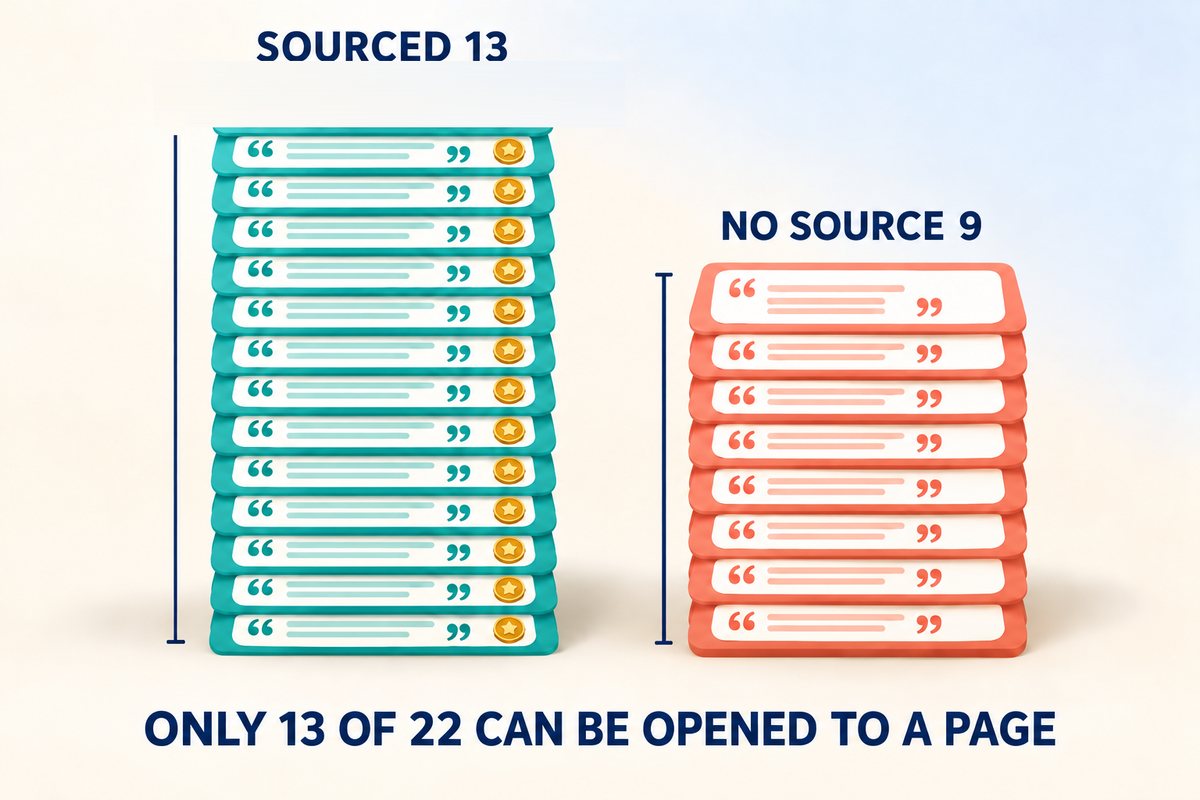
How many of these quotes can actually be traced?
We graded every line on this page by one test: can a reader follow the citation to a specific named work and read the sentence there? Nothing on this page is graded by how true it sounds.
| Grade | What the citation actually is | Quotes | Share of 22 |
|---|---|---|---|
| VERBATIM | Printed in a named book, interview or film, with a year you can look up | 13 | 59% |
| ATTRIBUTED | Credited to the person consistently by reputable sources, but with no single canonical origin | 7 | 32% |
| NO SOURCE | Credited to a named person whose own work contains no such line | 2 | 9% |
The second number is the one that surprised us. The 13 verbatim lines do not come from 13 places — they come from six, and a single 1989 interview collection supplies five of them:
| Named work | Year | Lines on this page | Share of the 13 |
|---|---|---|---|
| Market Wizards — Jack Schwager | 1989 | 5 | 38% |
| Reminiscences of a Stock Operator — Edwin Lefèvre | 1923 | 3 | 23% |
| Soros on Soros | 1995 | 2 | 15% |
| Trading in the Zone — Mark Douglas | 2000 | 1 | 8% |
| How to Make Money in Stocks — William O’Neil | 1988 | 1 | 8% |
| Trader (documentary) | 1987 | 1 | 8% |
Three things fall straight out of that table. The median year of a citable trading quote here is 1989. The newest one is from 2000 — nothing on this page that can be opened to a page was said in the last twenty-six years. And three of the 13 come from a book whose narrator is a fictional stand-in called Larry Livingston, written down by a journalist, which is a weaker kind of evidence than a transcript even though it is a real named source.
That is not an argument against old quotes. It is an argument for noticing that “trading wisdom” on the internet is mostly six books deep, and that the two crypto-era lines further down this page — the two most likely to be quoted in a group chat this week — are both in the middle grade, not the top one.
Which quotes about risk have a checkable source?
"Rule No. 1: Never lose money. Rule No. 2: Never forget Rule No. 1."𝕏 Share
Not literal — Buffett takes losses. It means: size and choose positions so no single loss is unrecoverable. That's the 1% rule in aphorism form.
"Losers average losers."𝕏 Share
Adding to a losing position feels like conviction and compounds like a disease — the recovery math shows why.
"It's not whether you're right or wrong that's important, but how much money you make when you're right and how much you lose when you're wrong."𝕏 Share
Win rate is vanity; expectancy is survival. Check what your plan implies in the risk/reward planner.
"The elements of good trading are: (1) cutting losses, (2) cutting losses, and (3) cutting losses. If you can follow these three rules, you may have a chance."𝕏 Share
"Never risk more than 1% of your total equity in any one trade."𝕏 Share
Said in 1989, still the professional consensus — see what happens at 10%.
What did the great traders actually say about waiting?
"It was never my thinking that made the big money for me. It always was my sitting."𝕏 Share
"The big money was not in the individual fluctuations but in the main movements — that is, not in reading the tape but in sizing up the entire market and its trend."𝕏 Share
"The stock market is a device for transferring money from the impatient to the patient."𝕏 Share
"There is a time to go long, a time to go short, and a time to go fishing."𝕏 Share
Flat is a position — but only when it is a conclusion, not a mood. “Nothing here matches my rules” is a decision you can write in a journal and check later; “nothing yet, I’ll look again in an hour” is restlessness with a chart open, and it usually ends in a trade you would have refused at nine in the morning. Same screen, same flat account, opposite outcomes.
Which trading-psychology quotes are documented?
"Everybody gets what they want out of the market."𝕏 Share
The revenge trader wants revenge, the gambler wants action, the professional wants process. The market pays all three exactly what they came for.
"I'm only rich because I know when I'm wrong. I basically have survived by recognizing my mistakes."𝕏 Share
"The consistency you seek is in your mind, not in the markets."𝕏 Share
Douglas's whole book in one line: outcomes are random per-trade; only your process can be consistent. That's what the journal measures.
"A loss never bothers me after I take it. I forget it overnight. But being wrong — not taking the loss — that is what does the damage to the pocketbook and to the soul."𝕏 Share
"Markets can remain irrational longer than you can remain solvent."𝕏 Share
In crypto this isn't a metaphor: "insolvent" has a price, and the liquidation calculator prints it.
How do professionals describe their own process?
"Where you want to be is always in control, never wishing, always trading, and always, first and foremost, protecting your butt."𝕏 Share
"Don't focus on making money; focus on protecting what you have."𝕏 Share
"Good investing is boring."𝕏 Share
"The whole secret to winning big in the stock market is not to be right all the time, but to lose the least amount possible when you're wrong."𝕏 Share
"Amateurs think about how much money they can make. Professionals think about how much money they could lose."𝕏 Share
Run your idea through the pre-trade checklist and notice which question you asked first.
Are there any crypto-era lines worth keeping?
"If you can't hold, you won't be rich."𝕏 Share
True for spot conviction; fatal for leveraged positions — the difference is funding and liquidation.
"Volatility is the price you pay for performance."𝕏 Share
A statement about unleveraged holdings. Add leverage and volatility stops being a price and becomes a trigger.
"In a bull market, everyone's a genius."𝕏 Share
The journal exists to tell you whether it was you or the tide.
Why do so many trading quotes get misattributed?
Four mechanisms account for almost every bad attribution, and this page contains a worked example of each one.
- Famous names absorb orphan lines. A sentence with no author drifts until it lands on the most quotable name in the field, and there it stays. That is the Keynes line above: a real sentence, a real 1986 first printing, and a man who had been dead for forty years by then. Nobody lied; the name simply had better gravity than the truth.
- A novel gets read as a transcript. Reminiscences of a Stock Operator is a 1923 book by a journalist, Edwin Lefèvre, about a trader called Larry Livingston. Livingston is Livermore thinly disguised, and the book is treated as his memoir — but the words on the page were shaped by a writer for a magazine audience. Three lines on this page come from it. They are genuinely sourced; they are not a recording.
- A paraphrase hardens into a quotation. Say something in four different ways across thirty years of interviews and the internet will eventually settle on one crisp version and put quotation marks round it. Buffett’s “Rule No. 1” is the best-known example: the idea is unmistakably his, the exact sentence has no single home, and it gets quoted as though it does.
- Screenshots launder the source away. A quote card on an image has no link, no year and no page number, and it is faster to share than to check. Every cycle produces a new crop of them. Ask one question before you repeat one: which book, which year? If the answer takes more than a minute to find, you are holding a tier-three quote.
The same reflex is worth more than the quotes are. A trade idea shared without its reasoning, a screenshot of a winning position with the entry cropped out, an “institutional” target price with no author — they fail the identical test, and they cost more than a misquote does.
How do you use a quotes page without fooling yourself?
A quote is compressed experience, and decompressing it means doing the work behind it. Pick one line that stings, work out which stage of the curriculum it belongs to, and drill that stage. Twenty quotes skimmed change nothing; one quote installed as a rule changes how you size. A practical version: copy the line into the notes field of your journal, and every time you break it, write down what you did instead. After twenty trades you will know whether you believe it or merely like it.
When is source-checking the wrong instinct?
Two cases, and both matter. First, an unsourced quote is not a false one. The Keynes line has no Keynes behind it and is still the most operationally accurate sentence on this page — in leveraged crypto, “insolvent” has an exact price and the liquidation calculator prints it. Grade the evidence, then judge the claim separately. Second, a perfect citation proves authorship, not applicability. Larry Hite’s 1% rule is verbatim from a 1989 book and was written for a futures fund with a risk desk; whether it fits an account of a few thousand dollars with 20× leverage available is a question the citation cannot answer for you. The grade tells you who said it. It never tells you that it applies to your account.
FAQ
Did Warren Buffett really say “Rule No. 1: never lose money”?
The idea is unquestionably his and has been stated in that spirit across decades of shareholder letters and interviews, but there is no single canonical citation — no one letter or transcript that everybody points to. That is why this page grades it ATTRIBUTED rather than VERBATIM. It is also not meant literally: Buffett takes losses. The working meaning is that positions should be chosen and sized so that no single loss is unrecoverable.
Did Keynes say “markets can remain irrational longer than you can remain solvent”?
There is no evidence that he did. The earliest known appearance in print is 1986, in a column by A. Gary Shilling, and Keynes died in 1946. No Keynes text containing the sentence has ever been produced. The line is graded NO SOURCE on this page. We keep it because the internet keeps crediting him, and because the sentence describes leveraged trading accurately whoever first wrote it.
Is Reminiscences of a Stock Operator a real source for Jesse Livermore quotes?
It is a real, named, datable source — a 1923 book by the journalist Edwin Lefèvre — but it is not a transcript. Livermore appears in it as a character called Larry Livingston, and the sentences were shaped by a writer for a magazine readership. Three of the 13 verbatim lines on this page come from it. Quote them as Lefèvre’s rendering of Livermore rather than as Livermore’s own words and you are on solid ground.
Which book supplies the most trading quotes?
On this page, Jack Schwager’s Market Wizards (1989) supplies five of the 13 verbatim lines — 38% of everything that can be traced, from one book of interviews. All 13 come from just six named works, with a median year of 1989 and nothing newer than 2000. If you want the primary material rather than the quote cards, that is where to start.
These quotes describe a discipline, not a shortcut
Almost every line here is about risk, patience and sizing — the unglamorous parts. Those are exactly what the curriculum teaches, in the order they matter.