DEX vs CEX — who holds the keys, and everything that follows from it
Every difference between a decentralised and a centralised exchange comes from one fact: on a CEX your balance is a claim on a company; on a DEX it is coins in a wallet you control. From that follow identity checks, support desks, fee structures, who watches your leverage, and what can be undone. This page lays those out and then says which to use, and when.
KEY TAKEAWAYS
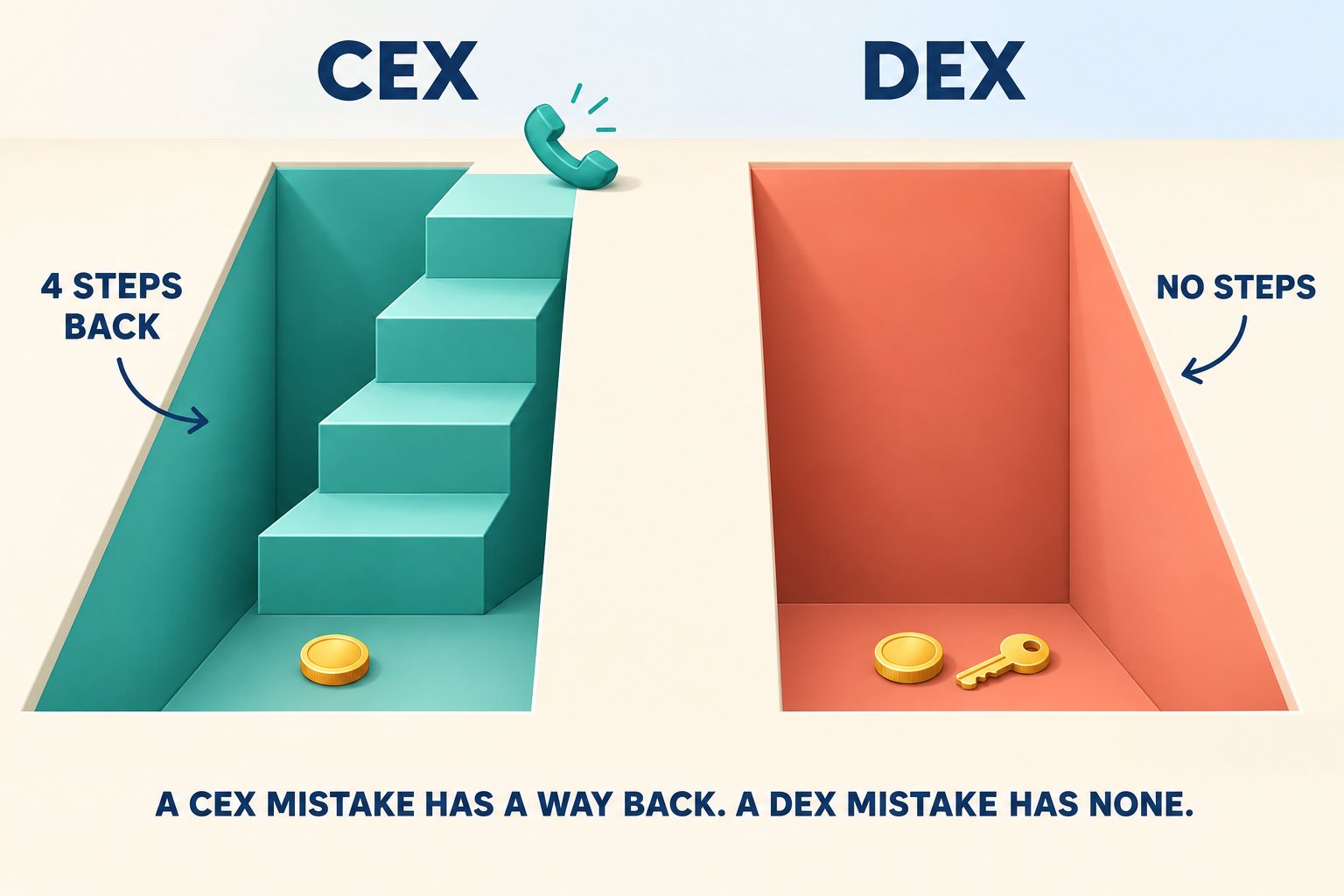
- On a CEX you hold a claim; on a DEX you hold a key. Lose the key and there is no account to recover, because there never was one.
- On perpetuals the DEX venues are slightly cheaper, not dearer: a $10,000 round trip costs $8–$9 on Aster or Hyperliquid and $10–$11 on Binance, OKX or Bybit. The whole argument is worth $3.
- A CEX checks your leverage continuously and can reduce or liquidate you; Hyperliquid’s documentation says leverage is checked only when the position opens.
- A CEX can freeze withdrawals, exit a region, or fail as a company. A DEX cannot freeze you — and cannot help you either.
- First account: CEX. Second venue, once you can manage a wallet without anxiety: a DEX for the specific job it does better.
What is the difference, in one table?
| CEX | DEX | |
|---|---|---|
| Where your coins are | On the exchange’s books; you hold a claim | In a wallet you control; you hold a key |
| Identity verification | Required before trading (Binance, OKX, Bybit) | Usually none; you connect a wallet |
| Support desk | Yes — tickets, chat, recovery flows | No. A mistake is final |
| Can withdrawals be frozen? | Yes, by the venue or a regulator | No — nobody holds them |
| Can the venue exit your country? | Yes (Binance left the EEA, 1 Jul 2026) | Access can be geo-blocked at the front end; the chain does not move |
| Who watches your leverage | The venue, continuously | Hyperliquid: checked only when the position opens; afterwards, you |
| Fees | Published maker/taker tiers — 0.02%/0.05–0.055% perpetuals at the regular tier; plus a liquidation clearance fee (Binance: 1.25% of position value on BTCUSDT) | 0.015%/0.045% on Hyperliquid, 0%/0.04% on Aster’s USDT perp; no clearance fee on liquidation, but withdrawal and builder-code costs are fixed and easy to miss |
| Advertised leverage | 100x–125x | Up to 1001x on Aster’s Easy Mode — a warning, not a feature |
| What can be undone | Some things, slowly, via support | Nothing |
| Proof of reserves | Published (Binance, OKX; Bybit audited by Hacken) | Not needed — balances are on-chain and yours |
| Venues we cover | Binance · OKX · Bybit | Hyperliquid · Aster · all DEX venues |
What does custody actually change?
On a centralised exchange, the number on your balance screen is an entry in the company’s database. The coins that back it sit in the company’s wallets, mixed with everyone else’s. You can ask for them back, and the venue can say yes, say wait, or — in a failure — say nothing. Proof of reserves exists because this arrangement needs reassurance: it shows the assets are there. It does not show the liabilities, which is the half that matters to you.
On a decentralised exchange there is no balance screen in that sense. Your collateral sits in a wallet whose private key you hold, and the venue is a set of contracts you interact with. Nobody can freeze it, exit your country with it, or lose it in a bankruptcy. Nobody can recover it either. Our DEX guide puts it in one sentence: losing your seed phrase is the end of the money, because there was never an account — only a key.
Everything else on this page is downstream of that (if the term itself is new, what a DEX is starts one step earlier). Identity checks exist because a company holding your money has legal obligations; a contract does not. Support desks exist because a company can reverse an internal entry; a chain cannot. Regional exits happen because a company is regulated somewhere; a chain is not anywhere in particular.

Who watches your leverage?
On a CEX, continuously. Binance, OKX and Bybit monitor margin in real time and will reduce or liquidate a position that breaches maintenance requirements; OKX’s documentation even warns that a funding deduction from equity may trigger position reduction. You may resent that at 3 a.m. It is also the venue doing your risk management for you.
On Hyperliquid, the documentation states plainly that leverage is checked only when the position opens. After that, monitoring is the user’s responsibility. Maintenance margin is defined — half the initial margin at maximum leverage — and liquidation will happen when it is breached, but the assumption that the venue is watching between trades is an assumption imported from a CEX, and on-chain it is false. The Hyperliquid review works through the arithmetic.
Aster advertises leverage up to 1001x on its Easy Mode. The leverage lesson shows that 100x already sits inside ordinary hourly price noise. We list the number because you will see it; we do not put the venue near a beginner because of it.
What do fees look like on each?
On perpetuals the two sides are closer than the argument suggests. At the entry tier the DEX venues we cover are slightly cheaper than the CEX venues, not dearer: Hyperliquid charges 0.045% taker and 0.015% maker, Aster’s own fee page lists 0% maker and 0.04% taker on its USDT perpetual, while Binance, OKX and Bybit charge 0.02% maker and 0.05–0.055% taker. Every figure below is read from the venue’s own published schedule; the dollar column is ours, computed on a $10,000 position.
| Venue | Type | Maker / taker, entry tier | Round trip, market orders | Round trip, limit orders |
|---|---|---|---|---|
| Aster | DEX | 0% / 0.04% (USDT perp) | $8.00 | $0.00 |
| Hyperliquid | DEX | 0.015% / 0.045% | $9.00 | $3.00 |
| Binance | CEX | 0.02% / 0.05% | $10.00 | $4.00 |
| OKX | CEX | 0.02% / 0.05% | $10.00 | $4.00 |
| Bybit | CEX | 0.02% / 0.055% | $11.00 | $4.00 |
Schedules read on the venues’ own pages: Hyperliquid and Binance 5 Sep 2026, Aster 11 Sep 2026, OKX 18 Sep 2026. Entry tier means no volume history, no token staked, no referral code. Fee tiers change; check the live schedule before you size a trade on these numbers. The fee calculator runs your own size across the CEX venues.
So the whole spread between the cheapest and the dearest venue on that round trip is $3. That is the number the DEX-versus-CEX fee argument is actually about, and it is small enough that it should not decide anything.
The cost that does decide something is not on either fee page. Binance charges a liquidation clearance fee of 1.25% of position value on BTCUSDT — on the same $10,000 position, $125. It is not in the fee schedule; it sits in a column of the Trading Parameters table. One liquidation costs 42 times the entire gap between the cheapest and dearest venue, and 25 times a single taker fee. Hyperliquid’s documentation says the opposite in plain words — “unlike CEXs there is no clearance fee on liquidations” — though in a backstop liquidation the maintenance margin is not returned, which is its own bill. What liquidation does is the part worth reading before the fee table.
What else is missing from the headline rate
- DEX: Hyperliquid charges a flat $1 to withdraw and enforces a $10 minimum order, so small round trips are dominated by fixed costs rather than the 0.045%. A third-party app placing your order through a builder code can add up to 0.1% — more than double the base taker rate — and it only appears when you sign the approval.
- DEX: a discount paid for by staking a volatile token is a position, not a rebate. Hyperliquid’s smallest staking tier cuts fees 5%: on a $10,000 round trip that is $0.45, in exchange for holding the token through a seven-day unstaking queue.
- CEX: the BNB fee discount switches off silently when the balance runs out, and on futures it must be BNB in the futures wallet, not the spot wallet.
- CEX: headline “0% maker” banners are promotions on particular pairs or a different settlement asset, not the standard schedule.
- Both: Aster’s two official pages disagree with each other — the dedicated fee page says 0% / 0.04%, the product overview says 0.01% / 0.035%. We use the fee page and say so.
When is the headline comparison the right comparison?
When you never use leverage. On spot there is no liquidation and no clearance fee, so the published rate really is the bill — and there the gap is wider and permanent: Binance and OKX take 0.10% taker, Hyperliquid 0.070%. A $10,000 spot round trip costs $20 on the CEX venues and $14 on Hyperliquid, a 30% saving that repeats on every trade. If you are buying spot and holding, the fee argument is real. If you are trading perpetuals with leverage, it is noise next to the liquidation line.
When does each one fail, and what happens to you?
| Failure | CEX | DEX |
|---|---|---|
| The venue goes bankrupt | You are an unsecured creditor. Recovery, if any, takes years. | Your coins were never on its books. You keep them. |
| The venue exits your country | Withdraw-only window, then nothing. Binance left the EEA on 1 July 2026. | The front end may block you; the contracts and your wallet do not move. |
| You lose your credentials | Recovery flow, identity re-check, support ticket. Slow, but exists. | Lose the seed phrase and the money is gone. No flow, no ticket. |
| You send to the wrong address or network | Sometimes recoverable via support, for a fee, if the venue controls the destination. | Never. |
| Your account is compromised | Whitelists and withdrawal delays can stop the thief leaving. Anti-phishing codes exist. | A signed transaction is final. The defence is not signing it. |
| Your leverage runs away | The venue liquidates you — painfully, but before the loss exceeds your margin. | Liquidation still happens on-chain; nobody warned you on the way there. |
Read the table as a whole rather than scoring it. A CEX fails in ways that involve other people and paperwork. A DEX fails in ways that involve only you and are instant. Which is worse depends on whether your bigger risk is the company or yourself — and for a first account, honestly, it is yourself.
Which first, which second?
First: a CEX. Binance for spot depth, Bybit for a demo that needs no deposit or ID, OKX once you are fluent in derivatives. The matcher asks five questions and picks one. Its failure modes come with a phone number, its screen watches your margin, and some mistakes can be undone.
Second, later: a DEX, for a job. Self-custody perpetuals on Hyperliquid (the hands-on version: how to start trading there) when you value verifiable fills and can manage a wallet without anxiety; markets a CEX does not list; or simply the principle of holding your own keys. Not as a first leveraged account, and not with size you would mind losing to a mistake nobody can reverse.
The test for readiness is not enthusiasm. It is whether you can explain, to someone else, what a seed phrase is, what happens when it is lost, and why leverage checked once is different from leverage checked always. If any of those three needs a search first, stay on the CEX for now.
What are the most common mistakes here?
- Treating “non-custodial” as “safe”. It means nobody else can lose your coins. It also means nobody else can save them.
- Bringing CEX assumptions to a DEX — expecting a support desk, a recovery flow, or a venue that watches your margin between trades.
- Opening a DEX first because it needs no identity check. The absence of KYC is a consequence of the absence of a company, and the company is what a beginner is actually relying on.
- Reading 1001x as an opportunity. It is the clearest warning on the page.
- Keeping everything on one venue of either kind. Two accounts beat one; a CEX and a DEX with separate roles beat two of the same.
FAQ
Is a DEX safer than a CEX?
It removes one risk and hands you another. Nobody can freeze your withdrawals or lose your coins in a company failure, because nobody holds them. In exchange, you are the only line of defence: a lost seed phrase, a signed transaction to the wrong contract, or a leverage you set once and forgot has no support desk behind it.
Do I need KYC on a DEX?
Usually not in the way a CEX requires it; you connect a wallet rather than open an account. Front ends can still geo-block some regions, and the venues we cover do not serve US persons.
Are DEX fees lower than CEX fees?
On perpetuals, slightly — and by less than people argue about. At the entry tier a $10,000 round trip on market orders costs $8 on Aster and $9 on Hyperliquid against $10 on Binance and OKX and $11 on Bybit: a $3 spread across all five. On spot the gap is wider and permanent, $14 against $20 for the same round trip. The number that dwarfs both is Binance’s liquidation clearance fee, 1.25% of position value on BTCUSDT, or $125 on that position — and it is not on the fee page. Every tier and hidden cost on Hyperliquid is worked through in Hyperliquid fees explained.
Which should a beginner use first?
A CEX. Its failure modes come with a support desk, its screen checks your leverage for you, and a mistake can sometimes be undone. Move to a DEX for a specific job once you can explain a seed phrase and what losing it means.
Can I use both?
That is the design. A CEX for the first account and for spot size on deep books; a DEX later, for self-custody perpetuals or on-chain markets a CEX does not list. Keep the roles separate and the balances small on whichever one you are learning.
Comparing the two biggest order-book perp DEXs? Hyperliquid vs dYdX works out where the cheaper venue changes hands — the fee schedules cross at exactly 50% maker fills — and why on dYdX the market’s open interest can raise the margin you have to post.