Part 4 — Trading strategy and entries
The overall approach: when to trade, how to enter, and how to avoid the large loss. All 6 slides in the order the course teaches them — each one explained underneath.
Trading Strategy — Entry point. Avoiding large losses. PART IV.
Slide 1 of 6
Trading strategy — 80% of the time the market is sideways. 20% of the time the market trends. Only trade. when the market trends. Identify the market's main trend. Read the main trend from the higher frames, D1 → W1. If the trend is up → buy, or wait to buy. If the trend is down → sell, or wait to sell. Step 1. Trade only with the main trend — it cuts out the mistakes that come from trading both directions. Focus. Patience. Avoid FOMO. Trading both directions leaves you inconsistent and ineffective.
Slide 2 of 6
Set the stop-loss amount, then work out the capital per trade — Step 2. How to calculate: Each stop loses at most 2% of the account, with the stop set where price has fallen more than 5%. → Volume = capital × 2% / 5%. Set the entry, the stop loss and the profit target. Step 3. Use what you know about RSI, when it pulls back cleanly. MA gives the same conclusion. Price at support, resistance or a channel → backs up what RSI and MA say. Price patterns, candles and volume all favouring the decision. When all four of those indicators agree, our analysis tends to be highly accurate.
Slide 3 of 6
Enter with the right size, and set the stop loss immediately after entering — Step 4. Watch and manage the trade. Step 5. If price hits the stop → start over. If price moves into profit → watch, and judge whether to add or to hold. Close the trade and write the trading journal. Step 6. This is the step that makes us better every day and cuts down the mistakes we have already made.
Slide 4 of 6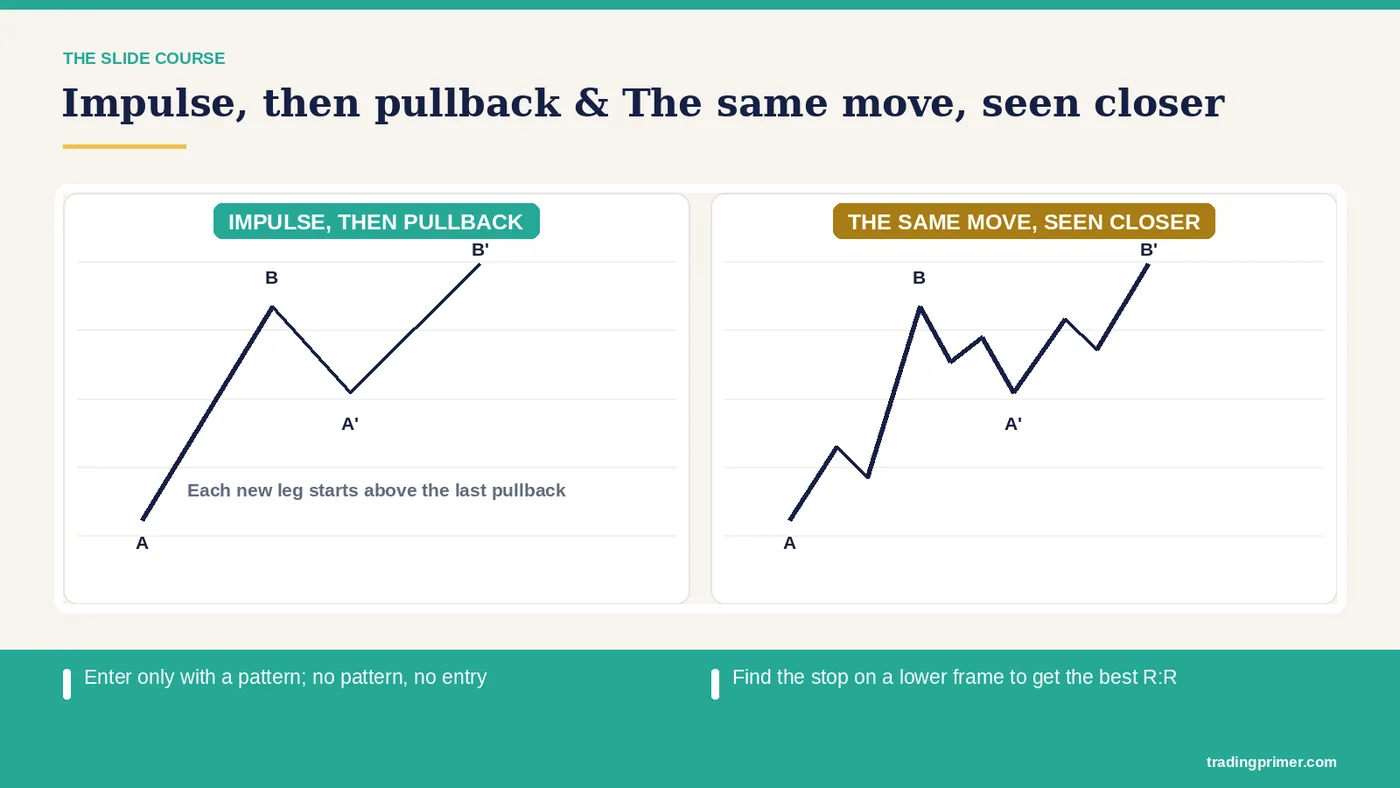
Entry point — Amateur: BUY A, SELL BProfessional: BUY A', SELL B'. Enter only with a pattern; no pattern, no entry. Find the stop on a lower frame to get the best R:R. Buy only on a buy pattern. Sell only on a sell pattern.
Slide 5 of 6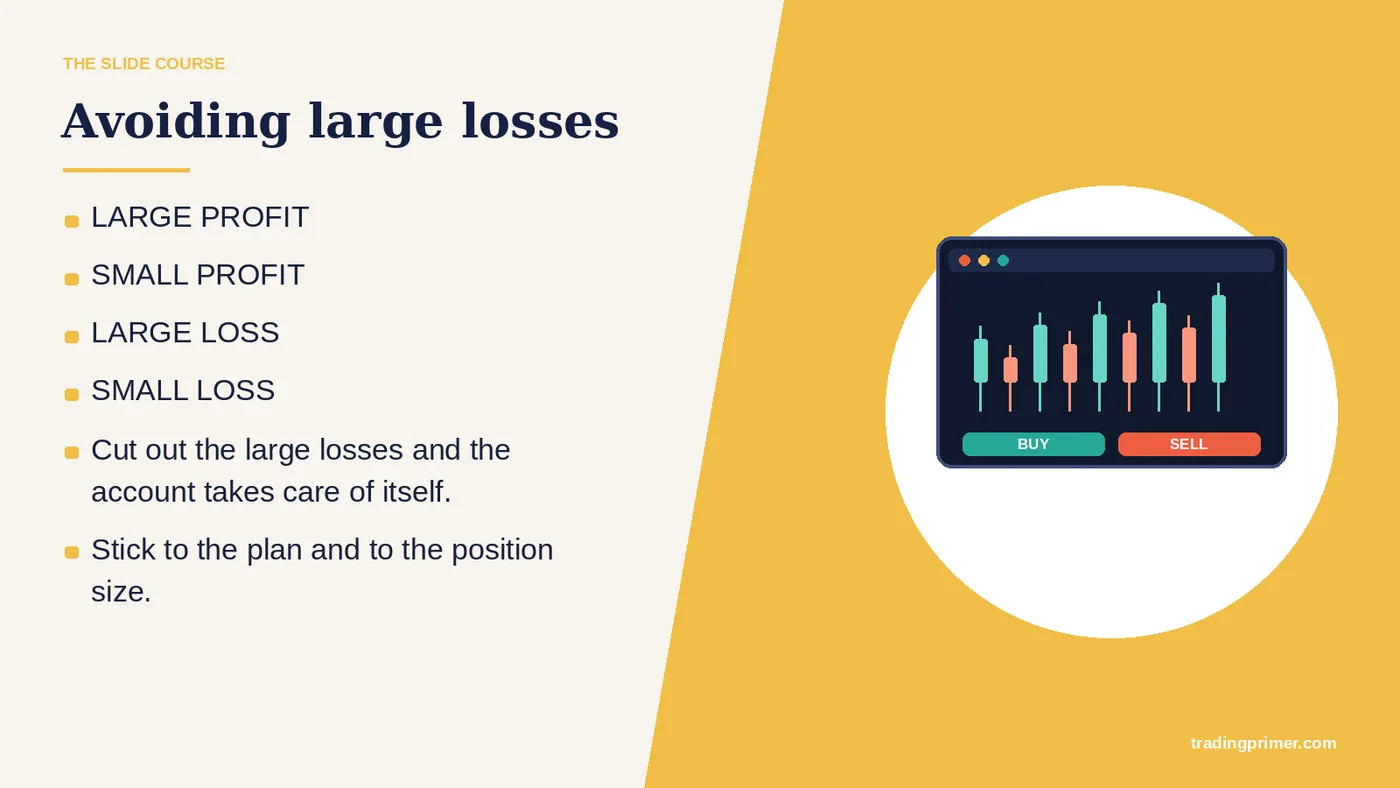
Avoiding large losses — Cut out the large losses and the account takes care of itself. Stick to the plan and to the position size. Stick to the stop-loss plan. Keep the share of winning trades at 40%. Reward/Risk ≥ 3. Three stops in a row and you stop, then come back to the market later. LARGE PROFIT. SMALL PROFIT. SMALL LOSS. LARGE LOSS.
Slide 6 of 6What this part covers
3 topics, in order. Each link jumps straight to that slide.
Prefer it as a PDF?
The same ten parts, downloadable, to keep next to your charts.